Summer 2026 Courses
The Ḥikmah Center is offering the following courses in the summer of 2026. Registration is now closed. Stay tuned for more information about the fall semester, God willing!
Seminar on The Muqaddimah of
Ibn Khaldūn
Seminar on the Bible

Seminar on The Elements of Euclid
Summer 2026
Course Descriptions
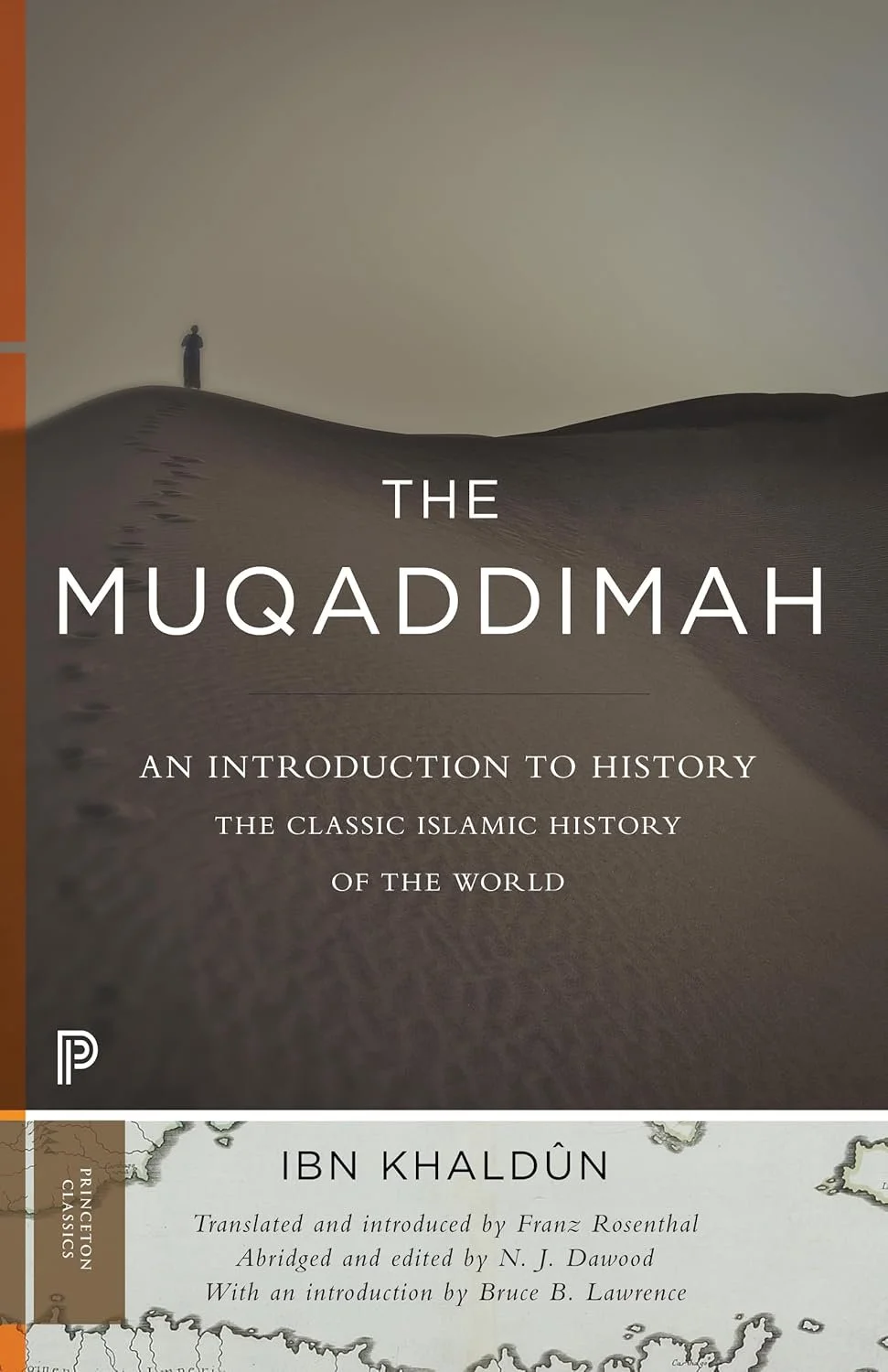
Seminar on The Muqaddimah of Ibn Khaldūn
The Muqaddimah of Ibn Khaldūn, by the author’s own testimony, is the first book to treat the study of human civilization as a science. The text is Ibn Khaldūn’s introduction to his multi-volume world history, and it frames that history as a series of emerging, developing, declining, and crumbling civilizations, each with its own lifespan, and each following a predictable course. The book traces the causes of historical patterns to the nature of human society, from its simplest forms to its most complex. Along the way, Ibn Khaldūn also takes time to discuss revelation, human knowledge, and the arts.
In this course, students will read a representative selection of passages from The Muqaddimah in translation. As a seminar, each session begins with an opening question from the instructor, after which students freely discuss the text, question it, and are questioned by it. The instructor guides the discussion by asking open-ended questions, and the group collectively comes to a deeper appreciation of Ibn Khaldūn’s ideas.
Course Reading Commitment: ~ 25-35 pages per week
Course Format: Online
Course Dates and Times: June 15 - August 17, 2026
Mondays, 6:00pm - 8:30pm Central (with a 20-minute break)
Seminar on the Bible
The Bible is a book that billions believe in, and that billions don’t read; a book that sparks violence, and that puts an end to it; a book that inspires faith, and that challenges it. The Bible is also many books, written by different authors, at different times, and in different places. But whether we see it as one book or many, it remains important, and those who read it carefully are likely to understand better than most the roots of today’s philosophical temperaments, whether those are based upon the adoption or the rejection of the Bible’s message(s).
This course brings students into contact with the Bible through a reading of key sections from the Hebrew Bible and the New Testament. Unlike a lecture, this seminar invites students to explore the message of the Bible on its own terms through open discussion. As a seminar, each session begins with an opening question from the instructor, after which students freely discuss the text, question it, and are questioned by it. The instructor guides the discussion by asking open-ended questions, and the group collectively comes to a deeper appreciation of the text.
Course Reading Commitment: ~20-50 pages per week
Course Format: In Person
Course Dates and Times: June 14 - August 16, 2026
Sundays, 6:00pm - 8:30pm Central (with a 20-minute break)
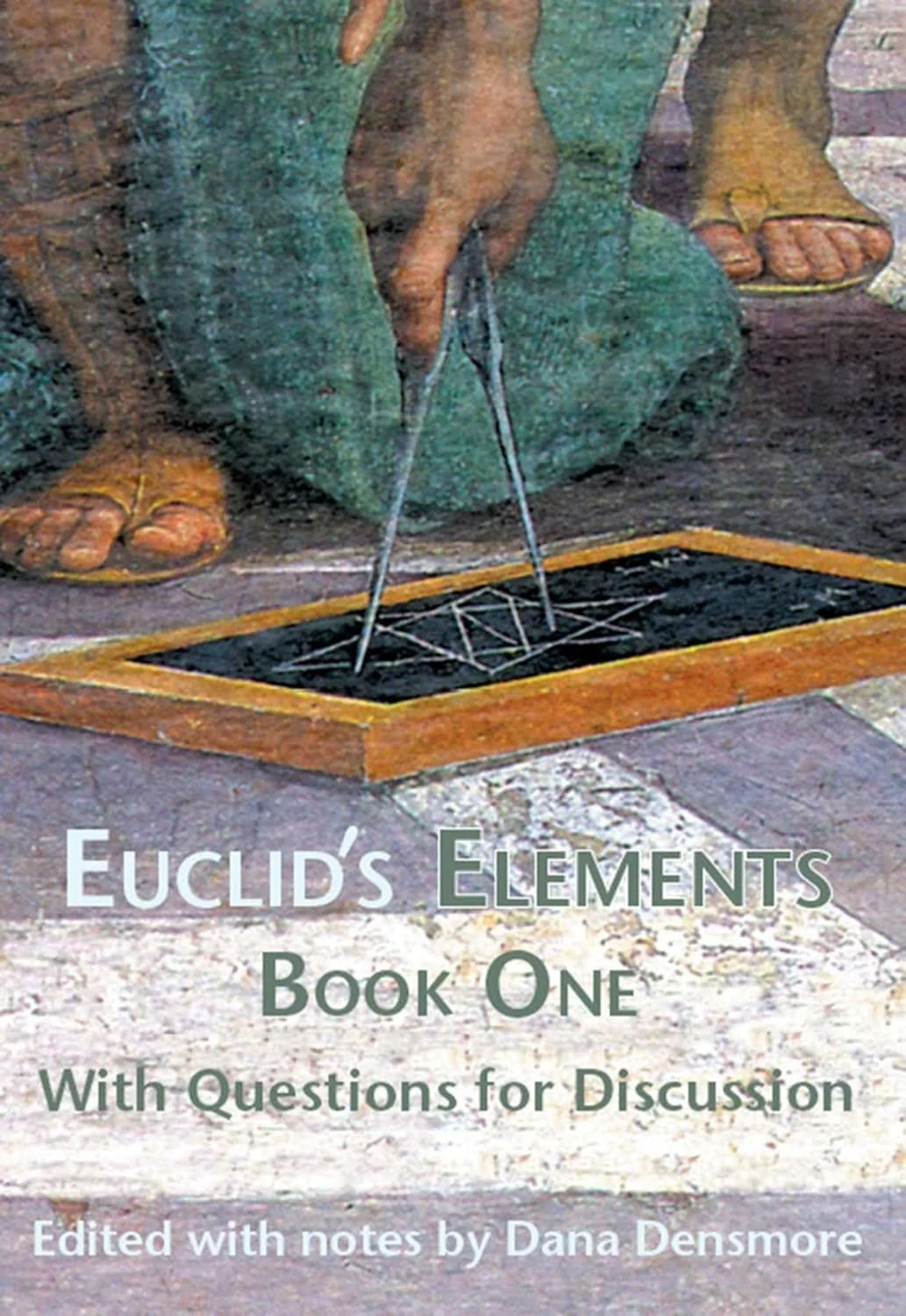
Seminar on The Elements of Euclid
The Elements of Euclid is about more than just lines, shapes, and angles. It’s about how just a few simple ideas, elements, can give rise to an entire system of mathematics. The text begins with a dozen or so definitions and first principles, which are simple and easy to understand. It then proceeds from proof to proof, demonstrating the complex properties of shapes in thirteen books that became the authoritative text on geometry for over a thousand years.
This course, God willing, covers the first book of The Elements, which includes Euclid’s definitions, first principles, and 48 propositions culminating in a proof of the Pythagorean theorem. Students will learn to construct geometric figures with a straight-edge and compass, to articulate mathematical proofs in their own words, and to show how their reasoning can be traced back to first principles.
These skills find important and immediate application in other areas of life, in which our ability to think well depends on our ability to provide arguments for what we believe in and to show how these arguments are rooted in first principles. Reading The Elements serves as a training ground for this kind of thinking.
The study of mathematics in this way (as opposed to the procedural variable-finding of today’s classroom) is so effective in enabling students to think clearly that Plato had a plaque above his academy’s door that read, “None may enter who has not studied geometry.”
Course Reading Commitment: ~ 25-35 pages per week
Course Format: In Person
Course Dates and Times: June 17 - August 19, 2026
Wednesdays, 6:00pm - 8:30pm Central (with a 20-minute break)

Important Information
Tuition
The Ḥikmah Center has a no-questions-asked-pay-what-you-can-reasonably-afford option this semester. Simply select this option during registration. Otherwise, standard tuition costs are:
First course: $450
Second course: $350
Third course: $250
Tuition is due in three parts: one third before the first class, another third before the third class, and another third before the fifth class.
Refunds: Students can drop a course at any time for a prorated refund.
Arabic Prerequisite
There are no Arabic prerequisites for the 2026 summer semester.

Other Information
-
The Ḥikmah Center has two, 14-week semesters in Fall and Spring, and a 10-week semester in Summer.
As a general rule, students are encouraged to bring physical copies of the course texts and take notes with pen and paper. Group orders of the physical texts is a possibility.
Online office hours for the summer of 2016 are offered by-appointment.
Students may enroll in as many or as few courses as they please.
In order to ensure that class discussions are private and candid, no class sessions are recorded by the instructor or students.
Ḥikmah Center offerings are for brothers only.
In-person classes are held near IANT in Richardson, TX. Details are provided for those who register.
-
About
Jonah Rudolph is a philosopher and lifelong learner whose intellectual interests center on philosophy, logic, theology, and classical literature. His passion is helping people think well by asking them questions that challenge them to better understand their own thoughts. He has experience tutoring Arabic grammar, translation, and textual analysis through works like the Mawqif al-ʿAql of Musṭafā Ṣabrī and the Tafsīr al-Jalālayn, as well as tutoring students reading Plato’s dialogues. He began the Ḥikmah Center in August, 2025, and he is currently its only instructor.
Education
Jonah graduated from the Bayyinah Dream program, a one-year Classical Arabic intensive, in 2016. He then received his ijāzah in the Islamic Sciences from the Qalam Seminary, completing the ʿĀlimīyah program in 2020. He earned a BA degree in liberal arts and Islamic studies from Zaytuna College in 2024. During and after the completion of his formal education, he has placed himself under the tutelage of ʿAlāʿ al-Dīn al-Kāsānī (d. 587/1191), Plato (d. 347 BCE), Aristotle (d. 322 BCE), Abū Ḥāmid al-Ghazālī (d. 505/1111), and many others.
-
In many ways, the Ḥikmah Center is an experiment in purposeful cultural craftsmanship. Each sphere of life has its own culture—the home, the school, the workplace, the coffeeshop. The Ḥikmah Center likewise has a unique culture. Discussants at the Ḥikmah center greet each other with, “What have you been reading recently?” rather than “Did you watch the game last night?” They speak about ideas rather than people or current events. And they seek to understand each other’s interior lives through reflection and compassion.
The Ḥikmah Center uses the title “brother” for all participants, including the instructor. This is because dialectic requires all ideas to be subject to the same level of examination. Ideas receive no special treatment because they happen to be the instructor’s. In order to represent this equality, titles like ustādh, shaykh, muftī, and doctor are not used, and all simply refer to each other as “brother.” This also serves to highlight the view that intellectual and moral excellence are not handed down from teacher to student but developed through the hard work of the student.
-
Attending courses at the Ḥikmah Center is more like attending a martial arts class than a movie. The movie-goer reclines and relaxes as the stimulus of the cinema washes over his senses. When courses are like movies, they become performances that students passively enjoy. In contrast, no student of martial arts expects to learn simply by watching the instructor perform the maneuvers. After a demonstration, students must get up, move, grapple, and eventually compete. The Ḥikmah Center’s pedagogy invariably focuses on student participation. Students spend as much time (preferably more time) speaking, conversing, and answering questions as they do listening to the instructor.
The martial arts analogy also applies to the Ḥikmah Center’s view on credentials and certification. The skill of a martial artist comes not from his belt but from his long years of training, for which the belt is only an approximate sign. In addition, no martial artist believes that he has completed his training, that he can relax, and that he will never lose his skill through lack of practice. Martial arts require consistent training. Likewise, the Ḥikmah Center offers no final certification; there is no “end” to the intellectual journey. Ḥikmah Center discussants continue to come and converse, sharpen their dialectical and philosophical fluency, and enjoy the company of the Ḥikmah Center’s intellectual community.
Lastly, the pedagogy of the Ḥikmah Center also resembles that of martial arts insofar as the martial artist’s worth is determined by his own skill. A pedigree of masters back to the founder of the art proves nothing if someone is a punching bag in the ring. Similarly, the Ḥikmah Center does not assign importance to scholastic pedigrees or religious chains of transmission in the absence of intellectual expertise and moral excellence as shown through dialectic and philosophical living.
The martial arts analogy does not apply, very importantly, when it comes to the spirit of competition. Only one fighter comes out of the ring a winner. Dialectic, on the other hand, is not about proving oneself better than anyone else. And philosophy, the third pillar, demands humility and eschews arrogance. The Ḥikmah Center is an inherently cooperative intellectual community.
-
In order to avoid untethered institutional growth, protect the small and intimate spirit of the Ḥikmah Center, and preserve the quality of education, the Ḥikmah Center observes the following limitations.
Class sizes are limited to no more than 10 students.
The Ḥikmah Center is to have no fundraising dinners, widespread advertising, or social media presence.
The Ḥikmah Center is to provide no certification, diploma, or other qualification which may threaten students’ sincere intention to better themselves or which may, by its public recognition, undermine the instructor’s duty to educate his students.
The Ḥikmah Center is to bestow no titles, such as ustādh, shaykh, or muftī, which serve to communicate one’s learning to others but which may become ends in themselves and undermine dialectic by creating authority.