Fall 2026 Courses
The Ḥikmah Center is offering the following courses in the fall of 2026. Courses are either “seminars” or “guided readings.” Seminars are guided discussions of English readings (no prior knowledge necessary), and guided readings are guided translations and discussions of Arabic texts (so Arabic reading proficiency is required).
Registration is now closed. If you have any questions, email Brother Jonah at thehikmahcenter@gmail.com.
(Book cover photos are for decorative purposes. There are often multiple editions students can use, and some courses feature multiple books.)
Seminar on the Dialogues of Plato
Seminar on the Works of al-Ghazālī
Seminar on the Treatises of Aristotle
Seminar on
The Venture of Islam
Guided Reading of the Mirqāt of al-Khayrābādī on Logic
Guided Reading of Select Kalām and Philosophy Texts
Fall 2026
Course Descriptions
Seminar on The Dialogues of Plato
Plato quotes his teacher Socrates, who said, “The unexamined life is not worth living.” This course is about examining one’s life, and gives students an opportunity to reflect on such questions as, “Can you learn to be a good person, or are you born that way?” “What is the ideal form of government?” “Is there life after death?” and many more. Plato’s writings uniquely facilitate the exploration of these questions because they take the form of dialogues, written conversations that we hope to bring back to life through our own discussions in class. Plato’s writings are therefore a blueprint for all seminars at the Ḥikmah Center. Sessions begin with an opening question, and the conversation has no fixed path, nor does it aim at any particular answer to the question. Instead, all ideas are heard, questioned, and evaluated as the conversation meanders away from, around, and back to the fundamental questions of the text.
In addition to offering students an opportunity to personally explore some of life’s fundamental questions, this course also familiarizes students with one of the most important philosophers of the Western and Islamic traditions, who had and continues to have a large influence on philosophy. Whether students have an interest in Stoics like Epictetus, Christians like Aquinas, Muslims like Rāzī, or Germans like Nietzsche, they will greatly benefit from reading Plato.
Course Reading Commitment: ~25-55 pages per week
Course Format: Online
Course Dates and Times: Sundays, 6:00pm - 8:30pm Central (with a 20-minute break)
14 sessions from September 6 - December 13, 2026
Seminar on the Works of Ghazālī
This course is a study of selected passages from the works of the Proof of Islam Abū Ḥāmid al-Ghazālī. Ghazālī is a deep, multifaceted, and intimately relatable scholar of Islam. We will read his autobiography, the Deliverance from Error, where we will learn about Ghazālī’s own struggle with skepticism, his encounter with various Muslim sects, and his journey from confusion to comfort. We will then explore Ghazālī’s understandings of kalām in Moderation in Belief, his spirituality in sections of The Revival of the Religious Sciences, his metaphysics in The Niche of Lights, and much more.
Unlike lectures, seminar sessions begin with a question from the instructor, followed by a group discussion. The discussion sometimes stays close to the text. Students reiterate Ghazālī’s points in their own words and come to a common understanding of the text with the help of questions from the instructor and from each other. At other times, the conversation diverges into other related matters. Students are always encouraged to voice their own ideas and to make connections between Ghazālī’s thoughts, the modern world, and their own lives.
Course Reading Commitment: ~25-40 pages per week
Course Format: In-person
Course Dates and Times: Sundays, 11:00am - 1:30pm
14 sessions from September 6 - December 13, 2026
Seminar on the Treatises of Aristotle
Among philosophers in the Arabic and Islamic tradition, Aristotle is called “the first teacher.” This title probably reflects his influence in that tradition more than it does his being the “first” to do anything. Indeed, Aristotle is in constant conversation with his predecessors, and his successors are in constant conversation with him. In many of his works, Aristotle summarizes the views of the Greek philosophers that came before him, critiques them, and synthesizes a philosophy that draws on the advantages of everything that came before him. In doing so, Aristotle became the main representative of Greek philosophy, worthy of being the main Greek interlocutor of such Muslim scholars as al-Ghazālī and Ibn Taymiyyah.
This course is one semester divided into two parts. The first seven sessions are dedicated to practical philosophy. Students will read Aristotle’s main work on ethics in its entirety, the Nicomachean Ethics, as well as sections from the Politics. They will encounter such questions as, “What does it mean to be a good person?” “How should one act toward money and fame?” “What is the ideal life?” and “Is being a good person the same as being a good citizen?” The second part of the course turns to theoretical philosophy. Through sections of the Physics, Metaphysics, and the De Anima, students will encounter questions about space, time, motion, infinity, causality, God, and the soul.
Course Reading Commitment: ~20-35 pages per week
Course Format: In-person
Course Dates and Times: Thursdays, 6:00pm - 8:30pm Central (with a break for prayer)
14 sessions from September 10 - December 17, 2026
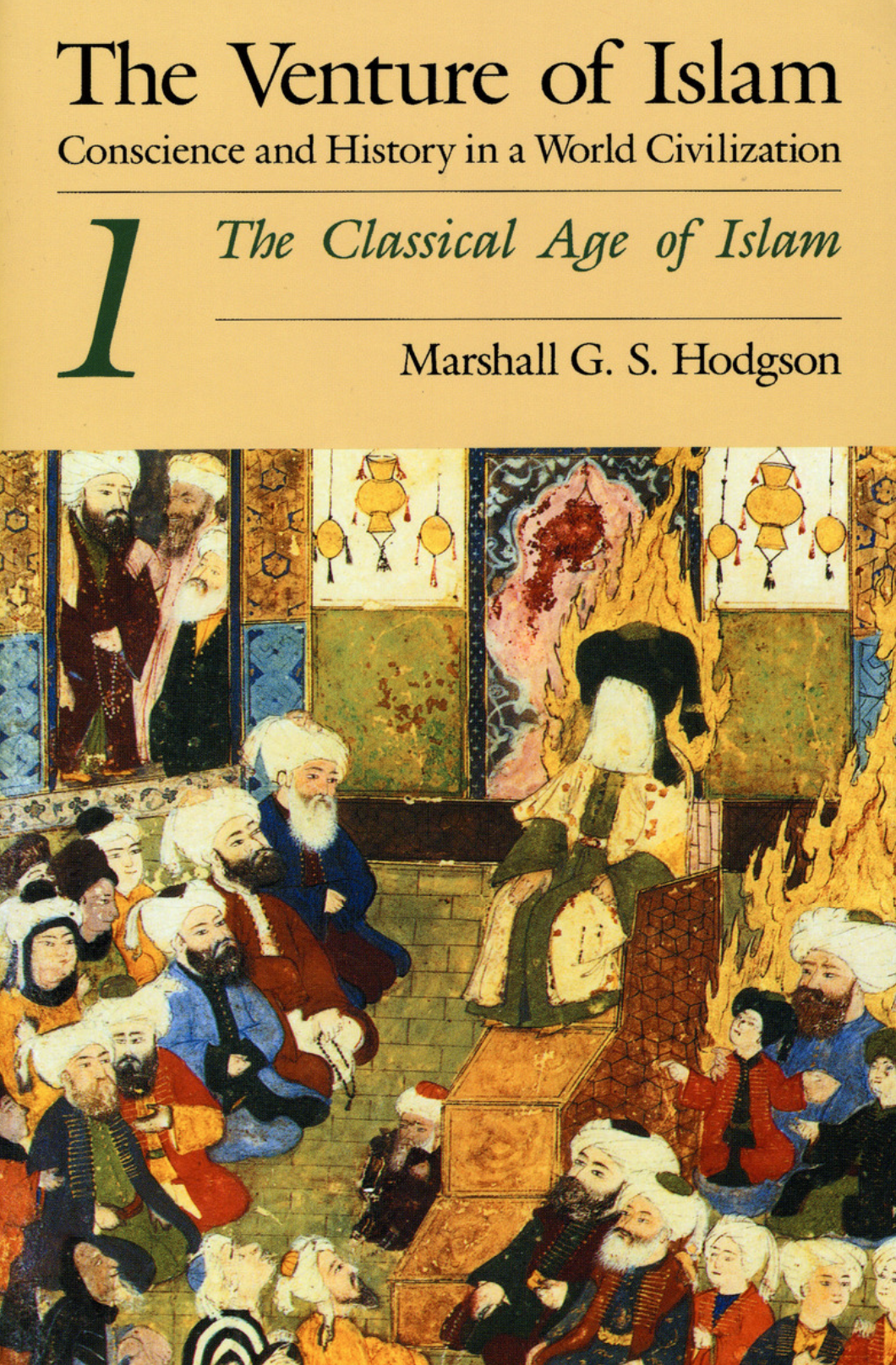
Seminar on The Venture of Islam
Marshall Hodgson’s The Venture of Islam is a three-volume text on the history of Islam. It is a foundational and highly influential text among Anglophone scholars of Islamic studies and continues to be studied at the author’s University of Chicago and elsewhere. Volume one explores the early period of Islam through the end of the absolute caliphal state in 945, with insights into Arabic literature, the absorption of Greek philosophy, and the birth of shīʿism. Volume two expounds the “middle period” through 1250 with sections on esoterism, sufism, and theology. The third volume follows the history up to 1950, evaluating the consequences of modern science, colonialism, and European world hegemony on various parts of the Islamicate world.
The Venture of Islam, as you can see, is about a lot more than the factual events of history. Likewise, this course aims not merely toward an explanation of basic facts but also the exploration of the different ways Islam has shaped the course of history. As with all Ḥikmah Center seminars, class time is dedicated to conversation and structured questioning of the text. This course is for students who can commit to reading approximately 40 pages of Hodgson’s (often dense) prose for one year split into fall, spring, and summer semesters.
Course Reading Commitment: ~40-50 pages per week
Course Format: Online
Course Dates and Times: Mondays, 6:00pm - 8:30pm Central (with a 20-minute break)
First Semester: 14 sessions from September 7 - December 14, 2026
This is a three-semester course with a total of 38 sessions.
Guided Reading of the Mirqāt of
al-Khayrābādī on logic
Formal logic is the science that prevents us from making mistakes in our reasoning. It protects us from using vague terms, false premises, and fallacious arguments and from falling victim to these mistakes when we hear them from others. Students of logic study the principles of valid definition, assent, and reasoning, and by applying these principles to their own ideas and those of others, they are able to filter out the distracting fallacies around them and pursue the truth with clarity and validity. The study of formal logic is also important because Islamic scholarly texts adhere invariably to the rules of formal logic, and they are replete with the Arabic logic terminology that students will learn in this course. A study of formal logic in Arabic is, therefore, indispensable for accessing the texts of the Islamic scholarly tradition.
This two-semester course introduces students to the Arabic logic tradition (manṭiq) through a close reading the Mirqāt of Faḍl-i Imām al-Khayrabādī (d. 1827-8). Khayrabādī was a leading scholar of the rational sciences (al-ʿulūm al-ʿaqliyyah), and his Mirqāt represents the culmination of logic primers in the Avicennan tradition. Students will learn the main terms of the Arabic tradition of formal logic in its broad division into concepts (taṣawwurāt) and propositions (taṣdīqāt). The course is mostly instructive in its approach, but students will be asked to read, translate, and reiterate concepts.
Course Reading Commitment: ~5 Arabic pages per week
Course Format: Online
Course Dates and Times: Tuesdays, 6:00pm - 8:30pm Central (with a 20-minute break)
First semester: 14 sessions between September 8 - December 15, 2026
This is a two-semester course with a total of 28 sessions.
Guided Reading of Select Kalām and Philosophy Texts
Every argument for God’s existence depends upon a certain understanding of the world. Some arguments make assumptions about time and space, others leverage a theory of causality, others rely on notions of unity, existence, the soul, complexity, and many other things. Arguments for the existence of God are not, therefore, the beginning of the conversation. What comes before them is a collection of questions about metaphysics and natural science, and how someone answers these questions has far reaching consequences on how he understands God and religion. The first half of this course will study a number of these metaphysical questions primarily through Ghazālī’s Maqāṣid al-Falāsifah. The second half of the course is dedicated to arguments surrounding God’s existence and attributes through readings of select kalām texts (and certain English ones as well).
The intention of this course is not to direct students to any particular doctrine or belief. Instead, this course aims to open up a conversation about how ideas about the world, God, and religion are interconnected, interdependent, and interwoven. As a guided reading course, students will read and translate the assigned Arabic texts with guidance from the instructor then discuss and evaluate the ideas in conversation.
Course Reading Commitment: ~5-10 Arabic pages per week (occasional English readings also)
Course Format: Online
Course Dates and Times: Fridays, 9:00am - 11:30am Central (with a 20-minute break)
14 sessions from September 11 - December 18, 2026

Important Information
Tuition
Standard tuition costs per-semester are:
First course: $599
Second course: $499
Each additional course: $399
If a course is more than one semester long, tuition is charged for each semester separately. In other words, tuition for the first semester is due at the beginning of the first semester; tuition for the second semester is due at the beginning of the second semester, etc..
Tuition for each semester is due in three parts: one third to confirm registration, another third before the second class session, and another third before the fourth class session.
Refunds: Students who drop a course before the 4th session are given a prorated refund. Beyond this, no refund is offered.
Financial Aid
The Ḥikmah Center has a no-questions-asked-pay-what-you-can-reasonably-afford option this semester. Simply select this option during registration. Otherwise, standard tuition will apply.
Early-Bird Discount
Students who register for a one-semester course before the end of Sunday, August 23 receive an automatic $100 off their full tuition. Students who register for a two- or three-semester course before Sunday, August 23 receive an automatic $150 off their full tuition. Students are eligible for only one early-bird discount per semester.
Arabic Prerequisite
Students registering for a “guided reading” course must be able to demonstrate Arabic reading and translation proficiency, and may be asked to schedule a live assessment to complete their registration.
In-person Location
In-person classes are offered in Richardson near IANT and the intersection of I-75 and Spring Valley Road.
Course Capacity
Courses are limited to eight students. Seats are given on a first-come-first-served basis.
Recording policy
In order to ensure that class discussions are private and candid, no class sessions are recorded by the instructor or students.

Other Information
-
The Ḥikmah Center has two, 14-week semesters in Fall and Spring, and a 10-week semester in Summer.
Class sizes are limited to no more than 7 students.
As a general rule, students are encouraged to bring physical copies of the course texts and take notes with pen and paper. Group orders of the physical texts is a possibility.
Students may enroll in as many or as few courses as they please.
In order to ensure that class discussions are private and candid, no class sessions are recorded by the instructor or students.
Ḥikmah Center offerings are for brothers only.
In-person classes are held near IANT in Richardson, TX.
-
About
Jonah Rudolph is a philosopher and lifelong learner whose intellectual interests center on philosophy, logic, theology, and classical literature. His passion is helping people think well by asking them questions that challenge them to better understand their own thoughts. He has experience tutoring Arabic grammar, translation, and textual analysis through works like the Mawqif al-ʿAql of Musṭafā Ṣabrī and the Tafsīr al-Jalālayn, as well as tutoring students reading Plato’s dialogues. He began the Ḥikmah Center in August, 2025, and he is currently its only instructor.
Education
Jonah graduated from the Bayyinah Dream program, a one-year Classical Arabic intensive, in 2016. He then received his ijāzah in the Islamic Sciences from the Qalam Seminary, completing the ʿĀlimīyah program in 2020. He earned a BA degree in liberal arts and Islamic studies from Zaytuna College in 2024. During and after the completion of his formal education, he has placed himself under the tutelage of ʿAlāʿ al-Dīn al-Kāsānī (d. 587/1191), Plato (d. 347 BCE), Aristotle (d. 322 BCE), Abū Ḥāmid al-Ghazālī (d. 505/1111), and many others.
-
In many ways, the Ḥikmah Center is an experiment in purposeful cultural craftsmanship. Each sphere of life has its own culture—the home, the school, the workplace, the coffeeshop. The Ḥikmah Center likewise has a unique culture. Discussants at the Ḥikmah center greet each other with, “What have you been reading recently?” rather than “Did you watch the game last night?” They speak about ideas rather than people or current events. And they seek to understand each other’s interior lives through reflection and compassion.
The Ḥikmah Center uses the title “brother” for all participants, including the instructor. This is because dialectic requires all ideas to be subject to the same level of examination. Ideas receive no special treatment because they happen to be the instructor’s. In order to represent this equality, titles like ustādh, shaykh, muftī, and doctor are not used, and all simply refer to each other as “brother.” This also serves to highlight the view that intellectual and moral excellence are not handed down from teacher to student but developed through the hard work of the student.
-
Attending courses at the Ḥikmah Center is more like attending a martial arts class than a movie. The movie-goer reclines and relaxes as the stimulus of the cinema washes over his senses. When courses are like movies, they become performances that students passively enjoy. In contrast, no student of martial arts expects to learn simply by watching the instructor perform the maneuvers. After a demonstration, students must get up, move, grapple, and eventually compete. The Ḥikmah Center’s pedagogy invariably focuses on student participation. Students spend as much time (preferably more time) speaking, conversing, and answering questions as they do listening to the instructor.
The martial arts analogy also applies to the Ḥikmah Center’s view on credentials and certification. The skill of a martial artist comes not from his belt but from his long years of training, for which the belt is only an approximate sign. In addition, no martial artist believes that he has completed his training, that he can relax, and that he will never lose his skill through lack of practice. Martial arts require consistent training. Likewise, the Ḥikmah Center offers no final certification; there is no “end” to the intellectual journey. Ḥikmah Center discussants continue to come and converse, sharpen their dialectical and philosophical fluency, and enjoy the company of the Ḥikmah Center’s intellectual community.
Lastly, the pedagogy of the Ḥikmah Center also resembles that of martial arts insofar as the martial artist’s worth is determined by his own skill. A pedigree of masters back to the founder of the art proves nothing if someone is a punching bag in the ring. Similarly, the Ḥikmah Center does not assign importance to scholastic pedigrees or religious chains of transmission in the absence of intellectual expertise and moral excellence as shown through dialectic and philosophical living.
The martial arts analogy does not apply, very importantly, when it comes to the spirit of competition. Only one fighter comes out of the ring a winner. Dialectic, on the other hand, is not about proving oneself better than anyone else. And philosophy, the third pillar, demands humility and eschews arrogance. The Ḥikmah Center is an inherently cooperative intellectual community.